
PALACE OF VERSAILLES HISTORY & FACTS
Palace and Park of Versailles
The Palace of Versailles, located 18 km from Paris, is one of the most iconic royal residences in the world. Built by King Louis XIV in the 17th century, it served as the seat of the government and a royal residence until October 1789 when the royal family returned to Paris. After the French Revolution, Versailles was no longer used as a royal residence and was neglected for years until it was transformed into a museum in the 1830s. Today, the Versailles Palace and its gardens are a lasting symbol of French art, history, and culture.

From Hunting Lodge to Versailles Estate
In 1623, King Louis XIII of France built a small hunting lodge in Versailles, a forested area west of Paris. After his death, the lodge was abandoned until his son, Louis XIV, became king and decided to transform it into a grand palace to show his power. In 1661, inspired by another beautiful château, Louis began expanding the estate and hired the same designers and artists to help with the project. Louis XIV personally watched over the construction, resulting in famous additions like the Hall of Mirrors, the North Wing, and extensive gardens designed in the French formal garden style. During the 18th century, King Louis XV and Louis XVI made further changes, adding buildings like the Petit Trianon and Marie Antoinette’s private village retreat, known as the Queen’s Hamlet.

King Louis XIV
Louis XIV, known as Louis the Great or the Sun King, ruled France from 1643. Upon becoming king, he moved the royal court and government to Versailles in 1682, transforming the palace into a symbol of his absolute power and making it both his residence and the center of government. The palace’s grand design, including the Hall of Mirrors, symbolized Baroque luxury and displayed France’s power and wealth, reflecting the King’s absolute rule. After the death of Louis XIV in 1715, following a 72-year reign, the longest of any European monarch, his five-year-old great-grandson, Louis XV, became king.
Marie Antoinette
Marie Antoinette, the last queen of France before the French Revolution, became queen in 1774 when her husband, Louis XVI, took the throne. She was heavily criticized for her extravagant spending and opposition to financial reforms, which many saw as a symbol of France’s economic crisis. During the chaotic events of the French Revolution, the royal family tried to escape, but both Louis XVI and Marie Antoinette were captured and imprisoned. Louis XVI was executed in January 1793, and Marie Antoinette was tried for treason and executed by guillotine in October 1793.

King Louis XVI
King Louis XVI was best known for being the last king of France before the monarchy was overthrown during the French Revolution. He is often associated with France’s severe financial troubles. Although he made some efforts to reform the government and address the financial crisis, the reforms failed to prevent revolution. He was executed by guillotine on January 21, 1793, after being found guilty of treason during the French Revolution. His death ended over a thousand years of monarchy and paved the way for the French Republic.
Want to learn more about the Palace of Versailles and its history?

Skip-the-Line
Versailles Guided Tour
Skip the line and enjoy an exclusive guided tour of Versailles Palace and its stunning royal gardens. Explore the extravagant State Apartments and the famous Hall of Mirrors with its 357 mirrors. Learn interesting facts about King Louis XIV and Marie Antoinette, the French Revolution, and other key moments in French history. Walk through the beautiful symmetrical Versailles gardens with over 50 fountains and statues and discover the beauty and history that make Versailles unforgettable.

Versailles day escape
Versailles Tour from Paris
Enjoy a tour of the Palace of Versailles from Paris with round-trip transportation and an expert guide. Travel comfortably with pre-booked tickets, skipping the long lines. Discover the beauty of the Palace’s interior, including the royal residences, the King’s and Queen’s luxuriously decorated bedrooms, and the famous Hall of Mirrors. Learn about the French monarchy and relax in the stunning Versailles gardens, filled with fountains, statues, over 200,000 trees, and perfectly manicured lawns. After your visit, enjoy a stress-free journey back to Paris.

The Gardens of Versailles
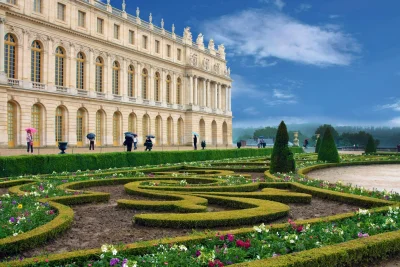
The Gardens of Versailles, created in the 17th century by André Le Nôtre for King Louis XIV, are known for their symmetry and geometric style, reflecting order and harmony. They include over 50 fountains and water features, 200,000 trees, ornamental flower beds, statues, sculptures, and grand features like the Grand Canal. Queen Marie Antoinette added her own section, and despite suffering damage during the French Revolution, they were restored and are now a UNESCO World Heritage site, celebrated for their beauty and historical significance.

Versailles in politics and culture
Versailles played an important part in the history of France, symbolizing both royal power and political changes. In 1919, the Treaty of Versailles, which ended World War I, was signed there. During Louis XIV’s time, Versailles was the center of government and the royal court, and it stayed that way until the French Revolution in 1789. The Palace was also a center for art and ideas, influencing European architecture and design.
Versailles during 19th century – museum & government venue
In the 19th century, Versailles saw significant changes. No longer a royal residence after the French Revolution, King Louis-Philippe turned it into a museum in 1837. During the Franco-Prussian War (1870-1871), it served as the Prussian headquarters, and the German Empire was proclaimed in the Hall of Mirrors. By the late 19th century, Versailles had become a symbol of French heritage, hosting key events and national gatherings.
Versailles in 20th century & today
In the 20th century, Versailles played a crucial role in history, with the Treaty of Versailles signed there in 1919. The Palace remained undamaged during World War II, and restoration efforts preserved it afterward. It became a major tourist destination and hosted important events.
Today, the Palace of Versailles is one of France’s most popular tourist attractions and a UNESCO World Heritage site. Visitors can explore its stunning rooms and enjoy its beautifully designed gardens. It also hosts special exhibitions, concerts, and contemporary art displays. The Palace remains a symbol of French history and culture, attracting millions of people each year who come to admire its architecture, art, and royal past.
Discover Versailles at your own pace!

Skip-the-Line
Versailles Palace & Gardens Ticket
Enjoy a day at Versailles exploring the Palace, Trianon, Marie Antoinette's Estate, and the famous Hall of Mirrors. Discover the State Apartments and learn about Louis XIV and the French royals. Walk through the beautiful estate with more than 200,000 trees, fountains, and sculptures. Visit the Royal Chapel, Grand and Petit Trianon, where the "Sun King" relaxed, and see Marie Antoinette’s private retreat.

Paris to Versailles round trip
Palace of Versailles Ticket with Transportation from Paris
Step into a world of French royalty at the Palace of Versailles with comfortable roundtrip transportation from Paris. Visit the King’s and Queen’s Apartments and walk through the famous Hall of Mirrors with 357 mirrors. Learn about the French monarchy as you walk through the stunning landscaped gardens with fountains and statues. Explore the Grand and Petit Trianon and Marie Antoinette’s charming village retreat.