
PALACE OF VERSAILLES ARCHITECTURE
About Versailles
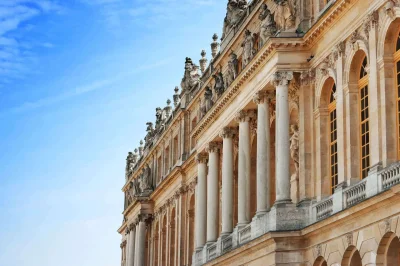
The Palace of Versailles is a stunning masterpiece of French Baroque architecture, celebrated for its grand, symmetrical layout and lavish details. Built in the 17th century under the reign of Louis XIV, it features large formal gardens, intricately decorated rooms with gold accents, and iconic spaces like the Hall of Mirrors. Designed to reflect the king’s power and wealth, Versailles used the finest materials, such as marble and gold, setting a new standard for royal palaces across Europe.
At the heart of its design is Louis XIV, the “Sun King”, whose vision placed him as the central figure, with everything symbolically revolving around him, just like the sun. Today, Versailles remains a symbol of royal luxury, serving as a lasting source of inspiration for both architecture and art.

Origins of Versailles
Versailles started as a small hunting lodge built by King Louis XIII in 1623, about 20 kilometers from Paris. After his death, his son, Louis XIV, expanded it into a grand palace in the 1660s. The construction of the Palace of Versailles started in 1661, and most of it was completed by 1682 when King Louis XIV moved the royal court there. The work continued for about 50 years, with more additions and changes even after Louis XIV died.

Architecture of Versailles
The architecture of the Palace of Versailles is an example of the French Baroque style, known for its grand, symmetrical, and lavish design. Some of the best artists, architects, and landscape designers of the time, like Louis Le Vau, André Le Nôtre, Jules Hardouin-Mansart, and Ange Jacques Gabriel, worked on it, combining classic design with creative innovation. The estate was built in the French Baroque style, featuring grand, symmetrical designs with detailed decorations and open spaces that show elegance, luxury, and power. The gardens were designed in the French formal style, with strict geometric layouts, long pathways, manicured lawns, and impressive fountains and other water features.
Want to learn more about Versailles Palace?

Skip-the-Line
Versailles Guided Tour
Skip the line and enjoy an exclusive guided tour of Versailles Palace and its stunning royal gardens. Explore the extravagant State Apartments and the famous Hall of Mirrors with its 357 mirrors. Learn interesting facts about King Louis XIV and Marie Antoinette, the French Revolution, and other key moments in French history. Walk through the beautiful symmetrical Versailles gardens with over 50 fountains and statues and discover the beauty and history that make Versailles unforgettable.

Versailles day escape
Versailles Tour from Paris
Enjoy a tour of the Palace of Versailles from Paris with round-trip transportation and an expert guide. Travel comfortably with pre-booked tickets, skipping the long lines. Discover the beauty of the Palace’s interior, including the royal residences, the King’s and Queen’s luxuriously decorated bedrooms, and the famous Hall of Mirrors. Learn about the French monarchy and relax in the stunning Versailles gardens, filled with fountains, statues, over 200,000 trees, and perfectly manicured lawns. After your visit, enjoy a stress-free journey back to Paris.

The Main Palace
The Palace covers over 63,000 square meters and has over 2,300 rooms, designed mainly by Louis Le Vau. It features a symmetrical design with long walls, grand staircases, detailed decorations, and an extensive art collection. The Garden Facade has neat, symmetrical lines, giving a sense of order and balance. The Palace was primarily used as the royal residence and included the North Wing buildings, South Wing buildings, Hall of Mirrors, King’s and Queen’s Apartments, the Royal Chapel, and the Royal Opera House.

The Hall of Mirrors
The Hall of Mirrors is one of the most famous rooms in the Palace. It was designed by Jules Hardouin-Mansart and decorated by Charles Le Brun in the French Baroque style. The Hall is 73 meters long, with 357 mirrors in 17 arches reflecting 17 windows that overlook the gardens. The Hall also has 43 chandeliers that light up the mirrors and decorations. Historically, the Hall hosted royal celebrations, balls, and diplomatic meetings. The Treaty of Versailles, ending World War I, was signed here in 1919. Today, it is a major tourist attraction sometimes used for state events.

The King’s and Queen’s Apartments
The King’s and Queen’s Apartments at Versailles are elegant, luxurious rooms that once served as private spaces for the royal family. The King’s Apartments, which include the King’s bedchamber, are richly decorated with furniture and artwork, showing the king’s power. The Queen’s Apartments, used by queens like Marie Antoinette, include the Queen’s bedchamber and a salon for receiving guests. They are elegantly decorated with tapestries and furniture. Both apartments display the wealth and status of the French monarchy with their grand and elaborate design.

The Gardens
The Gardens at Versailles, designed by André Le Nôtre, are a stunning example of the French formal garden style, known for its strict symmetry and geometric layouts. Covering 800 hectares, they feature neat, trimmed lawns, 200,000 trees, over 50 fountains, and statues inspired by Greek and Roman mythology. The gardens include the Grand Canal, a 1.5-kilometer waterway that was once used for boat rides. Long walkways lead to fountains and statues, reflecting order and beauty. The gardens display control over nature and symbolize the king’s authority, representing the height of French Baroque luxury and elegance.
The Fountains
The fountains at Versailles are a key part of the gardens, with over 50 fountains featuring statues and sculptures inspired by mythology. They were designed to show the king’s control over nature and reflect the grandeur of the French monarchy. Initially, there were about 1,400 fountains, though not all are working today. Famous ones include the Latona Fountain and the Apollo Fountain. The fountains are arranged symmetrically, adding beauty and elegance to the gardens.

The Trianon Estate
The Trianon Estate is part of the Versailles grounds and includes two smaller palaces, the Grand Trianon and Petit Trianon, along with beautiful gardens. The Grand Trianon was built in 1687 by Jules Hardouin-Mansart for King Louis XIV as a peaceful retreat known for its pink marble columns and elegant design. The Petit Trianon, built in 1768 for Louis XV, became associated with Marie Antoinette, who used it as her private escape. It has a simpler architectural design and charming gardens. The Trianon Estate offered French royalty a more relaxed and intimate space, away from the grandeur of the main Versailles Palace.
The Queen’s Hamlet
The Queen’s Hamlet at Versailles, built in 1783 for Marie Antoinette as part of the Trianon Estate, was designed by architect Richard Mique to resemble a peaceful French country village. It served as a retreat where the queen could escape court life and enjoy a simpler, rural lifestyle. The architecture is modest and rustic, featuring thatched roofs, timber frames, and stone walls, giving it a charming countryside feel. The Hamlet, which was built from natural materials like wood and brick, consists of 12 buildings, including a mill, dairy, barn, and several cottages, all arranged around a picturesque lake.
Royal Chapel
The Royal Chapel at Versailles, completed in 1710, is a stunning example of a French Baroque chapel. It had excellent acoustics for choir and organ music and was used for royal weddings, baptisms, and daily mass. It has two levels: the upper for the members of the royal family and the lower for the court. The Chapel is famous for its beautiful ceiling and stained glass windows. The chapel is one of Versailles’ most impressive areas, symbolizing the monarchy’s link to religion.
Looking to discover Versailles on your own?

Skip-the-Line
Versailles Palace & Gardens Ticket
Enjoy a day at Versailles exploring the Palace, Trianon, Marie Antoinette's Estate, and the famous Hall of Mirrors. Discover the State Apartments and learn about Louis XIV and the French royals. Walk through the beautiful estate with more than 200,000 trees, fountains, and sculptures. Visit the Royal Chapel, Grand and Petit Trianon, where the "Sun King" relaxed, and see Marie Antoinette’s private retreat.

Paris to Versailles round trip
Palace of Versailles Ticket with Transportation from Paris
Step into a world of French royalty at the Palace of Versailles with comfortable roundtrip transportation from Paris. Visit the King’s and Queen’s Apartments and walk through the famous Hall of Mirrors with 357 mirrors. Learn about the French monarchy as you walk through the stunning landscaped gardens with fountains and statues. Explore the Grand and Petit Trianon and Marie Antoinette’s charming village retreat.